Posts Tagged ‘language & culture study’

None of us know about God. Will you teach us?

Posted by Rachel Chapman on Tuesday, February 5th, 2013

The Nahuatl have a story about how the world ended.  In their version there was just water everywhere.  All the people had died and all the trees were gone.  There was just one man and his little dog in a canoe.  All the people in the world come from that man and his dog.

As I checked through the accuracy of my transcription of this story with my language helper, Leyo, she wondered aloud if it was really true.  I grabbed my Spanish Bible and showed her the story of the flood.  “These are God’s Words.  They are true words from Him to all people.  He tells what really happened when water covered the whole earth, but his story is a little different than your story.”

I told her that when I speak the language better, I want to write God’s Word so that all the Nahuatl can know God.  Leyo interrupted me, “We, none of us, know about God.  No one knows God.  You guys will teach us so that we will know?”

I assured her that I was going to do just that when I was able and she commented, “You don’t speak very well right now, do you?”

I agreed with her, but said that one day I would be able to teach her the Truth.

“That’s why you’re here,” she said.  “That’s good.” 

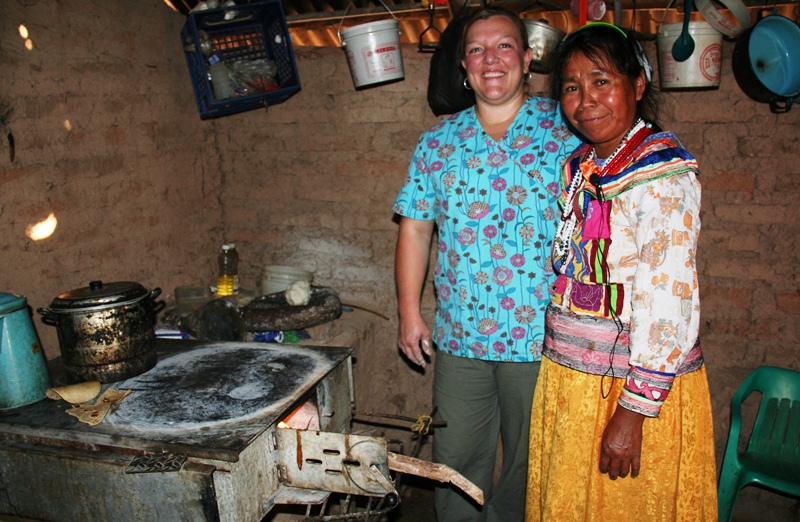
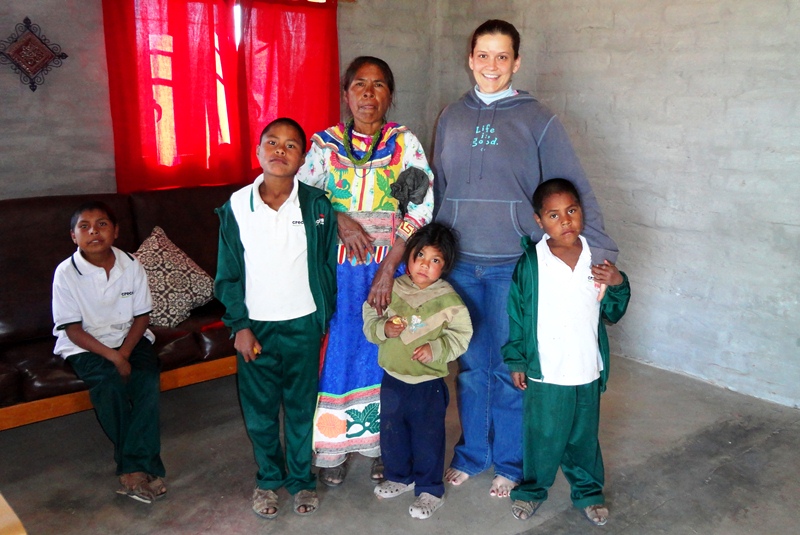
Leyo with her 3 youngest boys & her granddaughter. She washes my clothes every week and helps me learn Nahuat.l

Although I would love to be telling them of the hope we have in Christ, even Leyo knows that we don’t speak well enough yet.  Would you pray for Pete & Liesl, Katie, and me as we continue to study the Nahuatl culture and language?

Please pray for:

-Diligence in study, daily motivation, & energy

-Profitable study times with our language helpers

-Understanding of how the Nahuatl language works

-Ability to understand and speak accurately

Learn more about getting missionary training like Rachel received

Just another day

Posted by Rachel Chapman on Sunday, February 3rd, 2013

7:00 am – I woke up, got out of bed & got myself ready for the day.  I slept in this morning.  It was so nice to have the extra hour of sleep.  I feel refreshed and ready for the day.

7:15 – As I was putting in my contacts at the bathroom sink, I remember a plumbing problem we’ve been having with the bathroom drains.  So, I grab some tools and fix it.

7:40 – I had dishes from the night before.  So, while I washed dishes, Katie made breakfast.  We decide to head out the door to visit some Nahuatl friends about 9am.

8:00 – We sit down for breakfast – an egg, toast with sugar-free guava jam that Katie made, and chai tea.  Yum!

8:15 – Jasmine arrives and asks for diapers for her neighbor’s newborn.  We are surprised at the birth of the new baby.  We knew the mother was pregnant, but suspected her due date around April because of her size.  We sell our visitor a few cloth diapers for her neighbor and offer her coffee because it’s cold.

9:15 – Francine arrives, a 13 year old who has a few days off school because the teacher is at a teachers’ workshop.  She’s bored and wants me to make bread for her.  I tell her I really don’t have time to make bread.

9:23 – Jasmine leaves.  The solar panels have charged the batteries enough for us to turn on the inverter to use the internet.  Katie checks her email.

9:40 – Katie comes outside to visit with Francine so I can check email quick and get ready to go visiting. Francine wants to buy clothes, but she doesn’t have any money on her.  But, she wants to see all that we have to sell so if she wants anything she can come back with the money later and buy it.  We have some second-hand clothing and blankets that we make available to the people for very cheap.

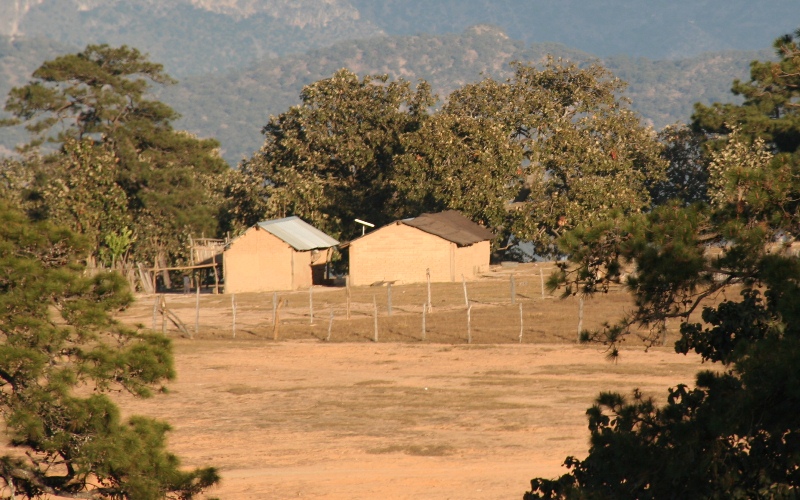
Heading out to visit the family in these houses and their neighbors

9:58 – We’re finally on our way out the door to visit.  We stop off at Katie’s language helpers’ house on an errand.  Then, we head next door to see the mom with the new baby, taking a present of crunchy tostada shells for the mother and a baby bundle, a gift we give to all newborn babies. (a fleece blanket, cloth diapers, a change of clothes, socks and a hat)  Many times, women have NOTHING for the baby when it is born.

A mom and her 2 day old baby

11:30 – We finish visiting and start to head home, stopping by the store to buy a few things we need – powder milk for coffee and some ramen noodles.

Our town store - if you want a Coke or chips, they always have it. If you want tortilla flour, wheat flour, or beans, you might be out of luck.

11:35 – The store is closed.  Owners aren’t home.  They’re probably working in their fields as it’s nearing harvest time. I’ll have to go back later in the afternoon.

11:45 – We get home.  I check email again and load new recordings on my MP3 player to listen to while I make lunch.

12:00 – I start getting lunch ready, listening to Nahuatl recordings at the same time to continue studying language while I work in the kitchen.  Sweet Potato & Carrot Curry with Canned Chicken!

12:35 – My Tuesday afternoon language helper arrives early.  Lunch is not ready.  I ask Katie if she’s okay eating whatever she can find.  I’ll finish the lunch later for supper.

12:40-1:30 – Leyo helps me with language questions that I’ve accumulated in the last few days, and we talk about culture – personal property and community property

1:30-2:00 – Leyo hangs around for some visiting.  We talk about what’s happening in the village and when I’m traveling to town next….

Leyo and her youngest sons and her granddaughter. The boys can be super goofy when they're all together!

2:00 – Leyo leaves, so I finish making lunch which will be supper.  I made extra so we can eat it several times this week, storing it in our solar powered refrigerator.  I cleaned up the kitchen, washed dishes & listened to some praise music instead of Nahuatl recordings because I was TIRED.

3:30 – I’m re-energized and ready to study.  I sit at my desk and transcribe two texts that I recorded a little bit ago about what is a good person and what is a bad person in the Nahuatl’s perspective.

4:15 – I finished transcribing, so I check my time sheet that I fill out every day.  What do I need to focus on with my time that’s left for today?  I have 6 hours on my time sheet already with 2 hours left to my goal.  I need to work on analyzing grammar and writing up what we’ve found in grammar.  And, I need to process more recordings so that I can listen to the speech patterns & write down the cultural information to pass to my teammates.  I’ll see what I can get done yet…

4:17 – I went to Katie’s office to ask her a question and ended up listening to the Nahuatl story she’s working on…. A bear grabs a girl while she’s out pasturing the cows and drags her to the edge of the cliff.  But, then he grabs her little pocket mirror to admire himself.  As he’s looking at himself, she kicks him in the back and he rolls over the cliff.  Nice story!  We end up exchanging language info, talking about new words we’re learning.

4:40 – I grab a blanket to wrap up with on the couch as it’s getting chilly now.  I’ll work on grammar for a little bit.

Trying to figure out the complexities of the Nahuatl grammar

5:00 – Katie´s laundry lady returns from washing her clothes.  Katie invites her in to warm up with a coffee.  I greet her and add to the conversation here and there in Nahuatl as I type out Nahuatl grammar rules in English on my computer.

5:15 – Other visitors arrive; I quickly save my work and put away my computer so I can help Katie host people in our house.  Since it is chilly, I offer the new arrivals coffee.  I heat water for them, make coffee, and visit with them until the coffee is drunk.

5:50 – All the visitors leave.  I sit down again to get a little more grammar work done.

6:30 – Our co-workers, Pete & Liesl, arrive for some prayer time together.  I heat up supper for Katie and I and we eat while we catch up.  How is Milo understanding the Bible teaching?   Have you heard anything new about when the well drillers are coming?  Did you know there’s a new baby in town?  Then, we pray.

8:00 – Prayer time over; Pete & Liesl head back to their house.

8:15 – Katie and I watch a show on our little 9in portable DVD player.

9:00 – I’m reading through the Bible, and right now I’m in Jeremiah, reading his prophecies to Judah after the first Babylonian invasion.

Blessed are those who trust in the Lord, and have made the their hope and confidence.
They are like trees planted along a riverbank, with roots that reach deep into the water.
Such trees are not bothered by the heat or worried by long months of drought.
Their leaves stay green, and they never stop producing fruit. Jeremiah 17.7-8

9:40 I turn the lights out and hope to sleep soundly, because there’s no sleeping in tomorrow!  I’ll be up before 6 to go running with Liesl.  And, I’ll do a day like this all over again!

Uyuli

Posted by Rachel Chapman on Wednesday, August 1st, 2012

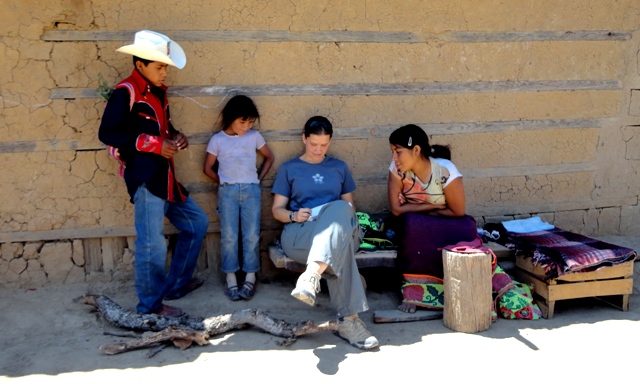
Checking words with Agustina while her siblings look on

I was checking words with my language helper a few days ago.  When I asked her about “uyulí” Agustina gave the definition as “it re-lived.”

“Like what, for example?” I asked.

“Oh, you know,” answered Agustina, “like if a plant is getting all dry and brown and you think it’s dead, but then it starts to turn green again and live.”

I asked if you could use that phrase to describe people.  “No.  How could you?  Once you’re dead, you’re dead.”

Agustina couldn’t imagine a way that a person could die and then live again.  She does not know the precious message of the Gospel where Jesus’ sacrificial death and re-living take center stage.  Please pray that the Holy Spirit would be moving in the hearts of the Nahuatl to prepare them to hear the message of new life.

An old Nahuatl tale

Posted by Rachel Chapman on Thursday, July 19th, 2012

A few days ago, one of our friends told Katie Moore the Nahuatl tale of the first man and woman.  It’s a fascinating story that echoes some of the Nahuatl values and points of view.  I’m sure you’ll recognize some familiar imagery, as well.

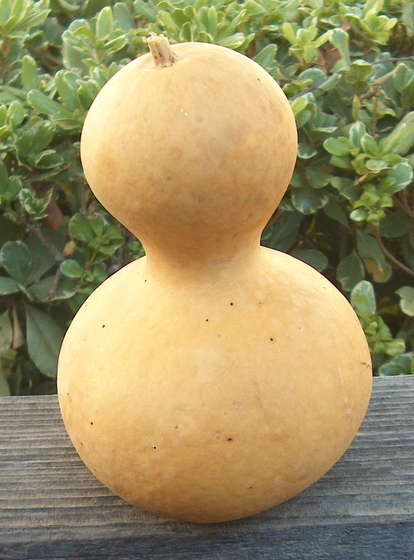
...there was a boat, like a gourd...

When the world was lost, it filled with water.  Everything was gone.  And when that was happening, there was a boat, like the gourds that the ancestors used to plant. A man and his dog put themselves inside.  When the water rose, they rose, too.  When the water receded, there they stayed on the ground.  But the ground was tender, so they didn’t get out; they stayed in the boat for many days.

They sent a bird—the kind that lives near the water, the kind that is somewhat like a duck, the kind that you can hear making its sounds near the river.  They sent this bird out from the boat to feel the ground and see how it was.  It’s not heavy and it wouldn’t get stuck; if the ground was still tender, it could fly away.

The ground was still tender; they could not leave.  For more days they stayed there until they knew that the ground began to be seasoned or mature.  So they got out.  The man got out and took the dog out.  And there was their house.  There they lived.   Then he started to work; the man softened the ground and planted.  And then he would go to work.  He would arrive at home in the afternoon and make his food.

...the tortillas were already made...

And so it went for some time.  Then he started getting home and tortillas were made.  And he wondered what it was.   He thought a lot about what it was.  He would get home and only the dog was there.

So, he went.  One time he went in the morning.  But he didn’t go; he stayed there checking close by so that he could figure out what.  He saw that a woman came out.  She came out from inside and went around the house and was grinding corn.  He saw her.  Later, the man ran to the house.  He saw that at the door was her hair.  The dog’s hair.  She had taken it off and put on a dress.

The man quickly grabbed the hair and he put it in the stove so that it would burn (the woman was making tortillas so that’s why the stove was lit).  He thought that if he did that, the dog would have to stay as a woman and be his woman.  That’s why quickly he burned it so that she couldn’t go back to being a dog.  The woman said to him, “Don’t burn it; it’s my shirt.”  But he didn’t listen to her.  She began to cry.  She became sad.

But the man thought that she should be his woman, because he was tired of being alone.  That’s how he saw it.  She could be his cook and it would be better.  The woman couldn’t do anything about it anymore.  She was people.  They lived together.  They had kids—boys and girls.  And from them came all the people that are of “the race”—Huicholes, and Tepehuanes, and Cora and us—lots of people.  Who knows where white people came from.

...he was tired of being alone.... She could be his cook and it would be better...

So the man worked.  And they had many things: goats, cows, chickens—many things.  Who knows where those animals came from, but they had them.  And that’s how the world is from then until now.  Even though it’s a long time since all that happened, the world is still the same.  It doesn’t change.  That’s how it happened.  That’s how they say it happened.

...our mother was a dog...

That’s why we know now that we women aren’t clean people.  Not clean like the men.  We have a rib from a dog and a rib from a person.  Our mother was a dog and the men’s father was a person.  We aren’t like the men.  That’s why it’s better to find a wife from far, far away and ask her and see if she’s in agreement with being your wife.  It’s better that way.  We women don’t remember well and that’s why.  Who knows if it’s true or not.  It’s a tale.  Well, I say a tale because we don’t see it happening right now.

Please pray for the day when Nahuatl men and women are one in Christ!

Baby Wearing

Posted by Rachel Chapman on Sunday, June 24th, 2012

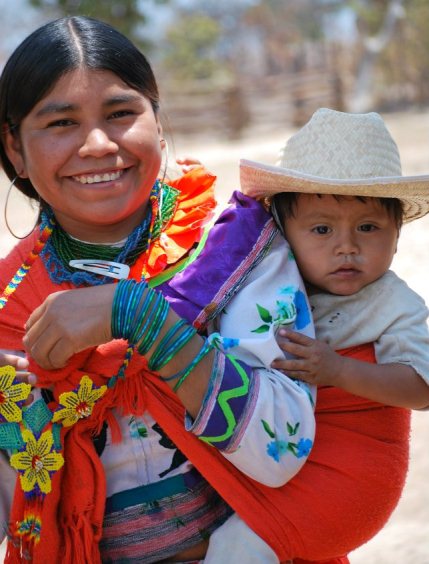
Baby wearing is not a new fad.  For hundreds, maybe thousands of years, the Nahuatl and other indigenous mothers have been wearing their babies.  Here is a 16 year old mother with her one year old:

I got to try my hand, or my back, at this ancient practice.  Katie was checking language with one of our Nahuatl friends.  Her baby was really fussy and I was trying to keep him quiet so Katie and our friend could concentrate on Nahuatl.  It wasn’t working, so I tried to give him back to his mother.  She picked up her shawl and said, “He want´s to be worn.  Here…”

I was scared to put him on because I figure he’d fall out of the shawl.  So, she tied him on me and I went about making lunch and doing other projects and he was as quiet as a mouse!

My first baby-wearing experience


This week

Posted by Rachel Chapman on Monday, June 11th, 2012

This week our house became a movie theater – complete with snacks: Tang and animal crackers!  The early showing was Narnia: The Lion, the Witch, and the Wardrobe.  The second showing was Planet Earth.  Both were much enjoyed!

Enthralled with Narnia

This week we studied Nahuatl.  We have a language evaluation soon, so we practiced as much as we could!

Checking words I have recorded to make sure they mean what I think they mean

This week I tried to haul water.  I went twice.  Once the water was just trickling.  I got about 30 gallons in 40 minutes.

Now, at the end of the dry season, there is very little water.

Meanwhile, I took pictures and talked to these cute kids in kindergarten.

The kindergarteners were washing up after their school lunch of beans and tortillas

This week I taught a little 7 year old visitor how to use my camera.  This was the result.

Not too bad for the first picture she ever took!

This week, Katie and I played Dominoes in order to learn how to teach others in Nahuatl how to play.  Sometimes studying is really fun!

Aska mishtokaró. Shihtal ini nih. -- It´s your turn. Put this one here.

And, finally, this week we stuccoed the outside of our house with our friends.  It was a long day!

Finishing up the last wall. Now, the rains won´t eat away at the adobe.

Well, that was the week in pictures.  Thanks for praying for us out here in Las Moras learning the language and culture of the Nahuatl people.  Please pray as we continue to build relationships and learn language so that we can clearly communicate God´s Saving Truth!

A little bit of Nahuatl

Posted by Rachel Chapman on Monday, May 14th, 2012

This is a story I’ve been working on the last couple of days.  Test your knowledge of Nahuatl (or see if you can decipher the Spanish mixed in!)  Be the first person to tell me what the story is about and I’ll send you a prize!!  Just click the “CONTACT” tab above or leave a comment.  Restrictions apply – family and coworkers are not eligible!

___________________________________

This is the place where the story starts....

Nel unitakati analko pa se lugar itoh Tehas.  Umpa yoh kinán nih.  Kwah tonalko tona i tawaki.  Kwah sewa, kichih sewa.  Hame pareho, hame lomas.  Aveces kiawíh.  Umpa así tormentas con ganas.  Inmalaka heheka kiahkokí kinmayawí miya nihkalme.  Umpa chantíl noiwan siwa, noiwan taka, nonanita.

Kwah nitakati, notatsi moneshtilitikáh patanistiyá pin nihavioneta.  I de ukán, timokambiaró pa usé lugar itoh Panamá kwah nel nipiyá nahwi años i noiwan siwa kátika tepichito.  Umpa insaka wehweyote i kwil verde porque kiahwíh mochi días.  Siempre kichih tona.  Umpa serka tichantiláh kaha playa.  Tiawilá miya veces a la playa.  Siempre tishgustaró tiaski pin playa i titaneloláh pin mar.  Igwal timopashaloltiláh pin bisi.  Aveces tiawiláh pin monte titamawisoláh.  Aveces pin nihtienda pa usé pweblo.  Umpa nichantiyá nipiyá de nahwi años hasta kwah nikátika de prepa.

I de ukán nimokwé usé pa analko usé lugar itoh Michigan.  Umpa kwil tahpa.  Sewakátika i wetsiyá nieve.  Nimoneshtili inBiblia, inDios, de useki táhtol pin universidad.  I de ukán nihnekiyá nikasaró pero intaka amo kinekiyá.  I de ukán nimokambiaró pa kaha Chihuahua.  I nimoneshtili inkastiya.  I de ukán uníh pa nitaishmá pin sierra.  I de ukán nikinishmati Tomás i Teresa i nishtenewiláh miya de Las Moras de nihgentis.  Kwakín nipensaro niwalas nichantí pa Las Moras.  I ya, niku nias unichih nokal i nichantití agusto.  Ya utám.

Wapurú

Posted by Rachel Chapman on Tuesday, May 8th, 2012

One day, Beni, one of the women of the village stopped by for a little visit with her girls.  We always enjoy their visits as they are very expressive and funny.  We always learn new words with them and they stretch our knowledge of the language in trying to understand them and talk with them.

As they were leaving, Katie gave the girls a red and white round peppermint.  The oldest one popped it into her mouth and said, “It tastes like wapurú!”  I grabbed my notebook and wrote, “wapurú.”

I thought, “This is great!  I was going to learn how to describe tastes and smells.  Here’s a word!”

So, in Nahuat, I asked, “What is wapurú?”  The girl answered, “Who knows!”

So, I asked, “Is it a fruit?”  The girl said, “Who knows!”

Then I said, “Is it sweet?”  The girl said, “Who knows!”

Getting nowhere with the daughter, I asked the mother.  She could not explain anything about what wapurú was, either.  So, I made a note to check it with my language helper the following day.

The next time I met with my language helper, I started by reviewing words or phrases that I had heard but hadn’t understood.  At the end of the list was “wapurú.”

I said, “Katie gave a candy to a girl yesterday and she said it tasted like ‘wapurú.’  What is that?”

She said, with slightly better pronunciation than the previous day’s visitors, “Vapurub?”

No more explanation needed!

Who knew?  Peppermints taste like VapoRub!

Tastes like peppermints!!

From Katie: Do you do that?

Posted by Rachel Chapman on Saturday, March 17th, 2012

Andrea gave Katie a few tamales one day after a visit

I meet at least twice a week with my language helper, a lady named Andrea.  She teaches me the Nahuatl language and answers a lot of my questions about how things work in this community.  Every time she explains something to me about her culture she asks, “And you guys?  Is it the same for you?  Do you do that?”  Many times I answer yes.  Yes, we have dances in our culture.  Yes, sometimes boys and girls start liking each other in school and then get married.  Yes, babies grow in our bellies, too.  Sometimes, however, the answer is more complicated.

A few weeks ago, Andrea was explaining to me about the local gods of the mountains.  She said that they are “clean” while the people around here are sinners.  Because of that, the spirits can help you if you make them a promise or bring them gifts.  If you bring them corn and fish and peaches after a good harvest, for example, they will make sure you have rain for the next season.  She went on to explain things in more depth and then asked me her standard question: “And you guys…do you do that?”  I told her that some people in my land thought like that, but that I didn’t.  I said that soon I was going to sit down and tell her what I thought in her own language, just like she had told me.  But first I had to study.  A lot.

Andrea, like many of the Nahuatl, do not communicate well in Spanish.  I know that she cannot understand the gospel well in Spanish and so I am trusting God’s timing as I continue to learn.

Please pray that our team will be diligent students while we work at learning how to communicate the Word to the Nahuatl.

Pray that the Nahuatl will begin to have questions and doubts about their beliefs that can only be met by the truth of the Bible.

From Katie: Not straight talking…

Posted by Rachel Chapman on Monday, March 12th, 2012

As we continue to spend hours daily studying the Nahuatl language, it is fun to see things start to take shape and make sense.  Several months ago I had written down “amomelahtaketsaliste” as meaning “a lie.”  We knew that the verb, to talk, is “taketsa” and “amo” means not.  Then, a few weeks ago, while studying some adjectives, we came across the word “melah,” or straight.

Suddenly, it became clear: a lie to the Nahuatl is “not straight talking.”  A perfect example of this kind of conversation comes from a young girl in another village.  She gets on the radio and spreads fear and confusion about what it takes to please God.  She tells the Nahuatl that they must dress in a different kind of clothes, perform certain dances so that it will rain, or stop using modern technology.  If the people fail to comply, they are warned about wild animals that will eat them or bad things that will happen to their family members.  We know that Satan has the Nahuatl trapped by his warped and twisted thinking.  We also know that we have the “straight talk.”

Please pray for God’s protection on the Nahuatl people until they have his truth.

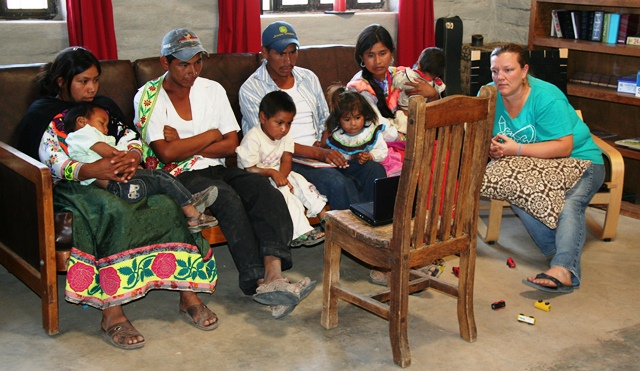
Nahuatl family - father, mother, and most of their kids