About
Church-planting

Simbari church worship
After years of culture and language study, David was first able to teach the Bible to the Simbaris in their own language in 2001. By the grace of God, there is now a small church body in this remote area of Papua New Guinea. Currently, David and Shari Ogg are working to meet the needs of this group of growing believers through Bible translation, teaching, discipleship and literacy. They are also working toward the spread of the Gospel to the rest of the tribe as well as the neighboring tribes. Please keep praying and may God be glorified as he continues to build His church!
About the Simbari
The Simbari people number approximately 4000 and live in isolated villages in the Highlands of Papua New Guinea. Papua New Guinea (PNG) is located just north of Australia and just south of the equator.

Papua New Guinea
Location: The altitude is approx. 5000 ft. and the area averages around 180 inches of rain per year. Because of the altitude the climate is cooler than the lowlands and clouds commonly build quickly around the mountains where surrounding us. Travel is by foot on rugged mountain paths or by small aircraft. There are no public utilities in the Simbari. Solar energy provides us with power and we collect rain water in tanks for drinking. An HF radio is used for communication and e-mail.
Local Foods: Staple foods are sweet potato, taro and yam. Many green vegetables grow well in the moist climate. There are plenty of leafy greens and beans. Fruits that grow locally include papaya, pineapple, guava and passionfruit. Pandanus trees that fill the high altitude rain forest provide a good protein source in delicious nuts that are eaten fresh (taste like coconut) or dried in racks above a fire to preserve them for up to a year. Some animals that are native to the area are a source of meat for the Simbari. Tree possums, birds, eels, frogs and cassowary, to name a few, are hunted and trapped by the men.
Traditional dress: Bark capes are a common piece of clothing to the Simbari. They are produced locally by harvesting the bark of specially planted trees. The skin is removed and pounded with a hand-stone that stretches them out into a large piece with a cloth-like texture. This is then tied at the top and worn on the head. It serves many other purposes as well. Special occasions like initiations are cause to dress up in traditional finery. These include: capes, grass skirts, shell beads, feather headdresses and headbands, etc.
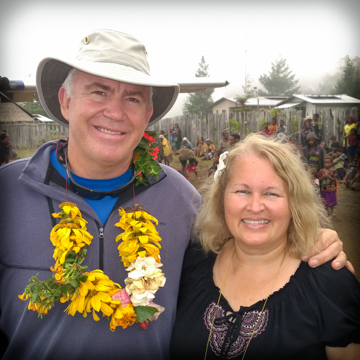
David and Shari Ogg Missionaries to the Simbari people of Papua New Guinea